 PMA Award Winner

Comprehensive Guide to Trade Show Displays: How to Choose a Booth That Actually Performs
Jul 10th 2026
Trade Show Displays: How to Choose a Booth That Actually Performs
Most guides to trade show displays read like a parts catalog — here are the sizes, here are the materials, pick one. At ExpoMarketing we firmly believe that the decision that matters is whether the booth does work for your brand on the floor: whether an attendee walking the aisle feels something about who you are before anyone on your team says a word.
Anyone can sell you a booth. What's hard — and what actually drives a return — is the design and judgment that turns a 10×20 into a brand moment.
The unique thing a great booth gives you is a brand connection with the people walking past it — and that connection is what makes them transact.
ExpoMarketing Ethos
This comprehensive guide is written from that point of view — the show-floor one. We'll cover the real types of displays and when each fits, how to actually choose, what a booth costs across its life (not just at purchase), and the unglamorous execution details that decide whether a show works. We've done this across every tier, for first-time exhibitors and veteran marketers.
Start here.
What is a trade show display, really?
Technically, a trade show display is the branded structure inside your booth space — "display," "booth," and "exhibit" all describe it. But functionally, it's the only salesperson on the floor who works while your team is mid-conversation with someone else. A good one earns the walk-up from forty feet away, signals that you belong there, and pulls in the right customers — not just a crowd. A busy booth isn't automatically a successful one. The job is attracting the people you actually want to talk to.
What are the types of trade show displays — and how do you pick a tier?
Displays come in three build families — portable, modular, and custom — and every one of them can be built backlit, with internal LED lighting that makes your graphics glow instead of just hang.
Backlit booths are a clear way to stand out and are absolutely worth the extra investment.
Renting is a fourth path that cuts across all of them. ExpoMarketing carries the full range deliberately, so the conversation can start with your goal instead of a price point — we meet you where you are.
Portable displays
Pop-ups, banner stands, tabletop kits, and lightweight portable-modular systems — built to travel light and set up fast, usually without tools or a crew. The right starting point for a 10×10, an occasional exhibitor, or anyone who needs presence without a logistics tail. Available backlit, too — our Beacon line brings illuminated impact to a portable footprint.
See ExpoMarketing's portable trade show displays — toolless fast-setup, best-value options for a 10×10.
Modular displays
Reconfigurable frame-and-graphic systems that scale across booth sizes using shared components — a 10×10 this quarter, a 20×20 at your flagship show, from one investment. Backlit panels build right into the system, so the same kit can light up as it grows. The smart pick for companies that exhibit often at changing sizes.
See ExpoMarketing's modular trade show displays — reconfigurable, flexible and available to meet all budgets and needs.
Signature line custom displays
Purpose-built environments engineered around your brand, your products, and the exact impression you need to make — including fully integrated backlit walls and features. This is where design control is total and the brand-connection payoff is biggest. Signature is ExpoMarketing's own custom-engineered product line — our highest tier — so "Signature" here names that brand, not just a custom build. Note that Signature line booths require a minimum of 4 weeks to be ready to ship, so start your conversations early.
See ExpoMarketing's custom trade show displays — purpose built and customized to convey maximum brand connection.
Rentals
Renting cuts across all of the above — you can rent portable, backlit, modular, or fully custom. It's the right call when you exhibit occasionally, need a large open-sided footprint just once, or want to test a design before committing to owning it, and it takes storage, refurbishment, and tied-up capital off your plate. The old worry — that a rental looks rented — only holds for a bare frame pulled from whatever a shop happens to stock. Wrapped in your branding, designed to your goals, and placed with real show-floor judgment, a rental delivers the same brand connection on the floor as a booth you own. Our edge is flexible, multi-vendor inventory access, so you get the size and configuration the show actually calls for.
See ExpoMarketing's custom trade show displays — limitless options for any configuration or style. Check out our options or see the full rental guide.
How do you actually choose the right display?
The honest first question isn't "what's your budget" — it's about the goal:
Do you just want to be the coolest booth on the floor, or a presence that's known and attracts the right customers?
From there, three practical inputs narrow it: how often you exhibit (occasional favors portable; a full season favors modular or custom you reuse), what size you book, and the impression you need to make. But the part you can't get from a spec sheet — and the part you're really paying for — is placement judgment.
Why is booth design a judgment call, not a template?
Start with layout: where you place your openings, counters, and focal points determines how foot traffic flows past your space and whether people feel invited to approach. From there it's the finer calls — where the reception counter goes and why, who walks past and from which direction, whether you want to gatekeep so only high-value conversations get through, or open the booth wide to invite everyone in. These decisions are the difference between a booth that's busy and a booth that's successful — and they come from years of watching real show floors, not from a configurator.
Our expertise turning goals and concepts into actual layouts and designs differentiates us from all other booth vendors.
A configurator can lay out a booth. It can't tell you that the demo station belongs on the back-right wall because of how traffic flows off the main aisle at that show, or that your counter is accidentally walling off the exact prospects you came to meet. That judgment is the product.
What size trade show booth do you need?
Space is sold in standard increments, and size drives budget, build type, shipping, and staffing.
- 10×10 inline (100 sq ft): the standard starting booth, backed against a wall and open to one aisle — a backwall, a counter, one or two staff.
- 10×20 inline (200 sq ft): a larger inline footprint with room for a demo or meeting area and storage.
- Peninsula (open on three sides): an end-of-row space facing two aisles, so more of the design has to work from multiple angles.
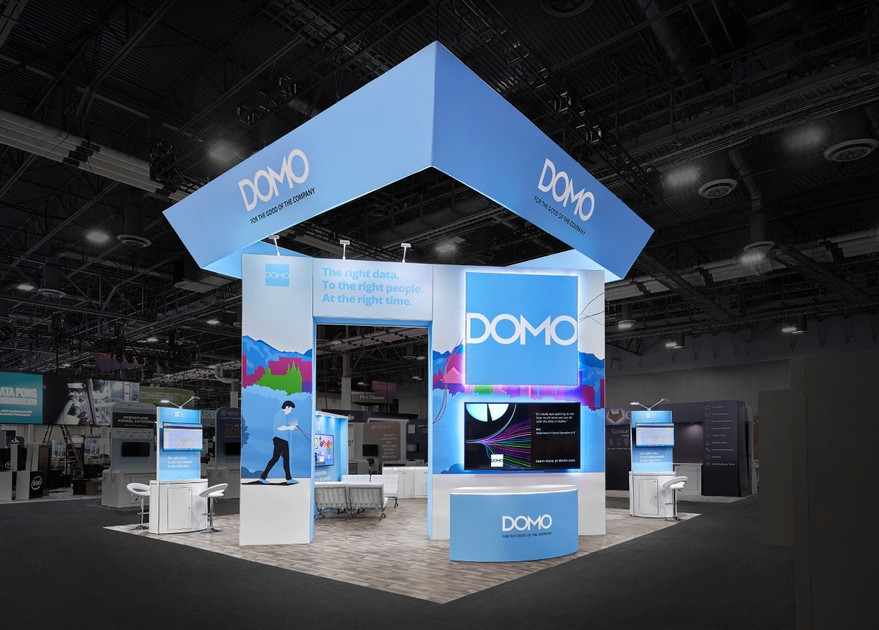
- Island (20×20 and up, open on all four sides): the design has to read and work from every direction — overhead signage, multiple stations, a strong center.
Each show sets its own booth rules — back-wall and side-rail height limits, line-of-sight, and hanging-sign policies — so check the exhibitor manual before you design. And bigger isn't automatically better: a well-designed 10×20 with one clear message will out-pull a sparse island every time — it's the design judgment, not the square footage, doing the work.
At larger island sizes, whole new formats open up: double-deck (two-story) exhibits that add meeting or lounge space above the floor, overhead hanging signs visible across the hall, and towers or archways that build vertical presence. These carry more lead time, engineering, rigging, and show approvals, so plan them early.
How much does a trade show display cost — over its whole life?
The number on the quote is the smallest part of the truth. The real cost of a display is its program cost: graphics refreshes between shows, shipping, drayage, install and dismantle labor, storage, and the booth's lifespan in shows — plus a contingency for the surprises that are effectively guaranteed on a show floor, where costs swing, labor runs behind, and fees balloon. Budgeting only for the hardware is how first-timers get blindsided. We'd rather walk you through the whole math up front — including the booth-lifespan math most vendors skip.
Need more info on budgets? Use one of the following Expo Marketing calculators:
Trade Show Budget Worksheet
Trade Show Drayage Calculator
Trade Show ROI Calculator
Trade Show Cost Calculator
And there's a reason to get it right the first time:
A trade show is the business version of a wedding — everything has to go right, and there's no coming back from the mistakes.
What makes a booth pull the right people in?
Hardware gets you in the game; design wins it. The principles that consistently draw the right crowd:
- One message, big. A prospect should grasp what you do from across the aisle — lead with a single benefit, not a logo and a paragraph.
- Height and light. Vertical elements and good lighting pull eyes up and over the competition.
- An intentional layout. Open to invite, or structured to gatekeep — but chosen on purpose, for who you want to talk to.
- A clear next action. A demo, a reason to scan, a moment that turns a glance into a conversation.
This is also why our conversations start with a free rendering, not a price list. Once a customer sees the design, the decision gets easy — resistance drops because they can finally picture themselves on the floor.
Should you buy or rent your display?
Buy when you exhibit regularly and want a consistent, owned asset. Rent for one-off shows, oversized footprints you don't want to store, or to test a design before committing — and renting sidesteps storage and refurbishment entirely. Our rental edge is flexible, multi-vendor inventory access backed by the same show-floor judgment, so a rental never feels like a generic frame. See our guide to choosing between portable, rental and custom booths for more details.
What about setup, shipping, and the things that go wrong?
This is the half of the job nobody puts on a brochure, and it's where shows are won or lost. Decide how the booth ships (advance warehouse vs. direct to show), budget for drayage — also called material handling, the general contractor's fee to move your freight from the marshaling yard or dock to your booth and back, and the most underestimated show cost — and know whether your show requires union labor for install. The reason to care who handles this: reliable shipping, ethical install-and-dismantle crews, on-site supervision, and graphics that show up wrinkle-free are the unglamorous things that decide whether the show works. White-glove execution isn't a luxury here; it's the difference between a brand moment and a scramble.
New to this? Here's the part stretched marketers actually need.
If you're attending a show doing a three-person job and being judged on whether the booth performed, you don't need jargon — you need someone to walk you through the show forms, the labor, the freight, and the booth-lifespan math, and then handle it. The emotional version of the goal is simpler than it sounds: show up, look great in front of your boss, and bring back leads. That's the bar we build to.
Frequently asked questions
What's the difference between a trade show display and a booth?
In practice, none — "booth" tends to mean the space, "display" the structure inside it. What matters is whether it does work for your brand on the floor.
What's the most cost-effective display for a first show?
For most 10×10s, a portable pop-up or tension-fabric display delivers the most presence per dollar including shipping and setup — but the layout decision matters more than the format.
Why does ExpoMarketing start with a rendering instead of a quote?
Because the design is the decision. Once you can see your booth on the floor, the rest of the conversation gets easy.
Can one display work at multiple booth sizes?
Yes — modular systems are built to reconfigure from a 10×10 to a 20×20 using shared parts.
Built for the show. Start with the design, not the price tag — explore our trade show displays or CONTACT US and we'll show you what your booth could look like on the floor.